 |
||||||||||||
|


|
|
 |
|
|
|
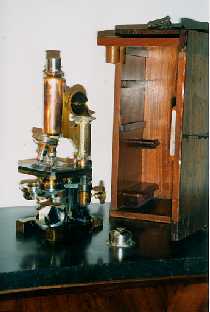
Reichert Mikroskop Wien Nr. 11623 um 1889 |
|
|
|
|
|
Below, you will find a publication to the subject Cytology, normaly in german language, in which is written down the original sentences of Rosenow, Wintrobe and Tavassoli: Neumann-Redlin
von Meding, E.: 130. aniversary of the cytolog(y)-´ical
foundation of modern hematology. Ernst Neumann describes the bone
marrow as blood forming organ with its common stem-cell for all
hematopoetic cells. Verh.Dtsch.Ges.Zytol.22 (2001)101-105
Die Flüssigkeit, die ich als Marksaft bezeichnen will, läßt sich mit
Summary: The importance of experimental cytology is exemplary observed in view of the development of modern hematology. E.Neumann got interest in the rising field of pathological anatomy by H.v,Helmholtz. In 1866 he was appointed professor of pathology and head of the new institute of pathology at Königsberg. Obtained by squeezing bones with his a new blood smear method, he desribed the presence of nucleated red blood cells in bone marrow sap of humans and rabbits. On the basis of this observation, he was the first to conclude that during postembryonic life, erythropoiesis and leukopoiesis is taking place in the bone marrow. Soon, he postulated a common cell for all hematopoietic cells. Unfortunately , outstanding contemporary investigators were reluctant to accept his novel ideas. Until his death in 1918 , he was creative in research so that additional discoveries are linked to this “Virchow of the East” , e.g. myelogenous leukemia, law of distribution of red and yellow bone marrow . Two universities awarded him honory doctorates (1898 Tübingen, 1914 Geneva) and American scientists rediscovered Neumann as “His Significance of Todays Hematology” (Rosenow, Wintrobe, Tavassoli). In 1995, the first Interational Ernst Neumann Award has been initiated by the 24.Meeting of the ”International Society for Experimental Hematology in Düsseldorf/ Germany. The first recipient of this award was Donald Medcalf from Melbourne. Mit der Beschreibung des heute in der klinischen Umgangssprache bezeichneten Nativpräparats (s.o.) stellte der Königsberger Pathologe und Hämatologe Ernst Neumann die Vorteile dieser Untersuchungsmethode im Jahre 1869 vor. 1877 machte Robert Koch diese ”Deckglasausstrichmethode” public (KOCH) , nicht wissend, daß Neumann hiermit bereits 1868 das Knochenmark als ausschließliches Organ der extrauterinen Erythrozytopoese erkannt hatte. Neumann fand bei der zytologischen Auswertung der Präparate im Hinblick auf das Studium der Knochenheilung kernhaltige rote Blutkörperchen und ließ sie, in Analogie zu der seit Kölliker bekannten embryonalen Blutbildung in der Leber, aus "lymphoiden Markzellen" entstehen. (NEUMANN) . 1870 beschrieb er die knochenmarkbedingte Leukämie, die er alsbald ”Myelogene Leukämie” nannte. Auch wenn Neumann durch den Einfluß Paul Ehrlichs eigene Färbemethoden verwendete (Pikrocarminfärbung) und gefärbte histologische Schnitte zur Grundlagenforschung heranzog, so verteidigte er bis zur Erstellung seines Blutzellstammbaums stets das Nativpräparat ohne Zusätze. Rosenow, ein Schüler Neumanns, schreibt hierzu: He explained to me how much could be learned aubout cells from unstained preparation.s. ´Nowadays´, he said, ´many people are greatly impressed by the beautifully stained histological sections and neglect to examine the cells fresh, unstained.´ He told me that before staining techniques were general used, pathologists as VIRCHOW, MARCHAND and he himself scaped a bit from the cut surface of an organ, put a drop of saline on and microskoped this fresh preparation” (ROSENOW). Vergleichende Beobachtungen an unfixierten und ungefärbten Präparten von der embryonalen Leber und vom frisch ausgepressten Knochenmarksaft ließen Neumann zu dem Schluß kommen, dass es nur eine pluripotente “großlymphozytäre Stammzelle” (1912) mesenchymalen Ursprungs gibt. Der Streit mit Paul Ehrlich war unausweichlich, dessen dualistische Lehre für jede Blutzellreihe postembryonal eine eigene Stammzelle vorsah. Um ihn von der Wichtigkeit frischer zytologischer Befunde auch in der umstrittenen Stammzellfrage zu überzeugen, schlug Neumann einen Beweis seiner Theorie vor: Analog zu Robert Kochs Bakterienkulturen forderte er eine Kultur speziell für das isolierte Wachstum der Blutstammzelle unmittelbar nach der Entnahme aus dem Knochenmark (NEUMANN, E.,1912). Neumanns weitsichtigen Erkenntnisse wurden zu ihrer Zeit von A.Maximow und F.Weidenreich C.Bernard sowie A.Pappenheim im Rahmen der Gründung der Berliner Hämatologischen Gesellschaft gewürdigt (PAPPENHEIM). Nach seinem Tode geriet Neumann in Vergessenheit. Erst die Amerikaner G.Rosenow, M.Wintrobe und M.Tavassoli erinnerten in den 80-iger Jahren an die große Zytologische Leistung des Königsbergers. Wegen der derzeitigen Diskussion um den Ernst Neumann Award (s.u.) zitiere ich diese Autoren im Original: ”Neumann examined besides the blood the pus-linke looking bone marrow microscopially: He found the white cells in the blood and those in the marrow morphologically identical” (ROSENOW). ”Neumanns discovery was announced in the form of a preliminary report. The promised thorough description appeared the next year in an extensive article. In the interim, two communications appeared in Italien and were soon translated in the Centralblatt. They were both by G.Bizzozero, Turin. Of the two, Neumann was a more persistant student of the subject. He continued his work on the marrow, and toward the end of the century produced other classic contributions. Among his ”firsts” were the identification of leukemia and of pernicious anemia as diceases of the marrow. He coined the term myelogeneous leukemia. Despite the intensity of the search, Neumanns observations did not catch on easily. His ideas were received with the same skepticism with which Immanual Kant´s Critique of Pure Reason had been greeted almost a century before. Neumann was supported by Bizzozero and by Claude Bernard, but there were also Pouchet and Hayem to repudiate him. ...Again, it was Neumann who provided us with the classic statement. In 1882, he enunciated the rule governing the devolopment of yellow marrow. In effect, he recognized a phenomenon that is sometimes referred to us as -Neumann's law. It states that at birth all bones that contain marrow contain red marrow. With age, the blood producing activity contracts toward the center of the body, leaving the more peripheral bones with only fatty marrow. For about 50 years, students of the marrow did not know what to make of this phenomenon. ... Despite all the opposition, however, within two decades, Neumann's discovery was a scientific axiom! The brilliance of the truth may first be blinding, but ultimately it supersedes all artificial illuminators” (TAVASSOLI, 1980, p.62-72)
Neumann and Bizzozero “reported observations and drew conclusions that were so revolutionary that they were not accepted” (M.WINTROBE, 1985). Beschränkten sich die eben zitierten Amerikaner in den 80-er Jahren mehr auf Neumanns umfassendes Werk für die Entwicklung der modernen Hämatologie des 19.Jahrhunderts, so rückten Neumanns Visionen von der einen postembryonal existierenden Blutstammzelle mit Hinweis auf deren kulturelle Anzüchtung seit den neunziger Jahren des 19.Jahrhunderts in den Vordergrund. Auf dieser Hypothese Neumanns, die sich als richtig erwies, basieren heute die neuen Fächer der Immunologie, Reproduktionsmedizin und Embryonalstammzellforschung. Neumanns wurde im Rahmen 450-Jahrfeier der Albertus-Universität zu Königsberg, dem heutigen Kaliningrad 1994 gewürdigt (NEUMANN-RvM. 1995). Anlässlich des des 24.Meetings der ”International Society for Experimental Hematology vom 27.8. – 30.8.1995 in Düsseldorf kam es zur ersten Preisverleihung zum neu gegründeten “Ernst Neumann Award”. Der erste Preisträger war Prof. Metcalf, Australien. Den Festvortrag hielt G. Brittinger (vergl. Seite Ernst Neumann-Award). So verbeugen wir uns heute vor der großen Leistung des Wissenschaftlers Ernst Neumann, der vorwiegend anhand von zytologischen und histopathologischen , nicht gefärbten Frischpräparaten die postembryonal existierende pluripotente Blutstammzelle im Knochenmark folgerichtig beschrieb und damit den Weg zur modernen Hämatologie bis in das nunmehr begonnene 21.Jahrhundert geebnet hat. Literatur zur Arbeit der 11. Tagung der Gesellschaften 2001 in Flims/Schweiz: Wintrobe, M. : Hematology, the Blossoming of a Science; a Story of Inspiration and Effort. Lea & Febiger Philadelphia 1985
|
|
|
| [welcome] [Ernst Neumann] [Pathology] [Hematology] [stem cell] [Cytology] [Award] [Literature] [Archive] [celebrations] [Rediscovery] |